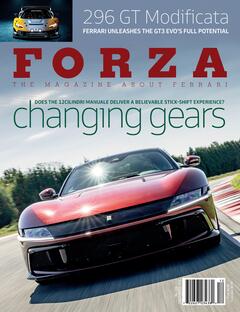
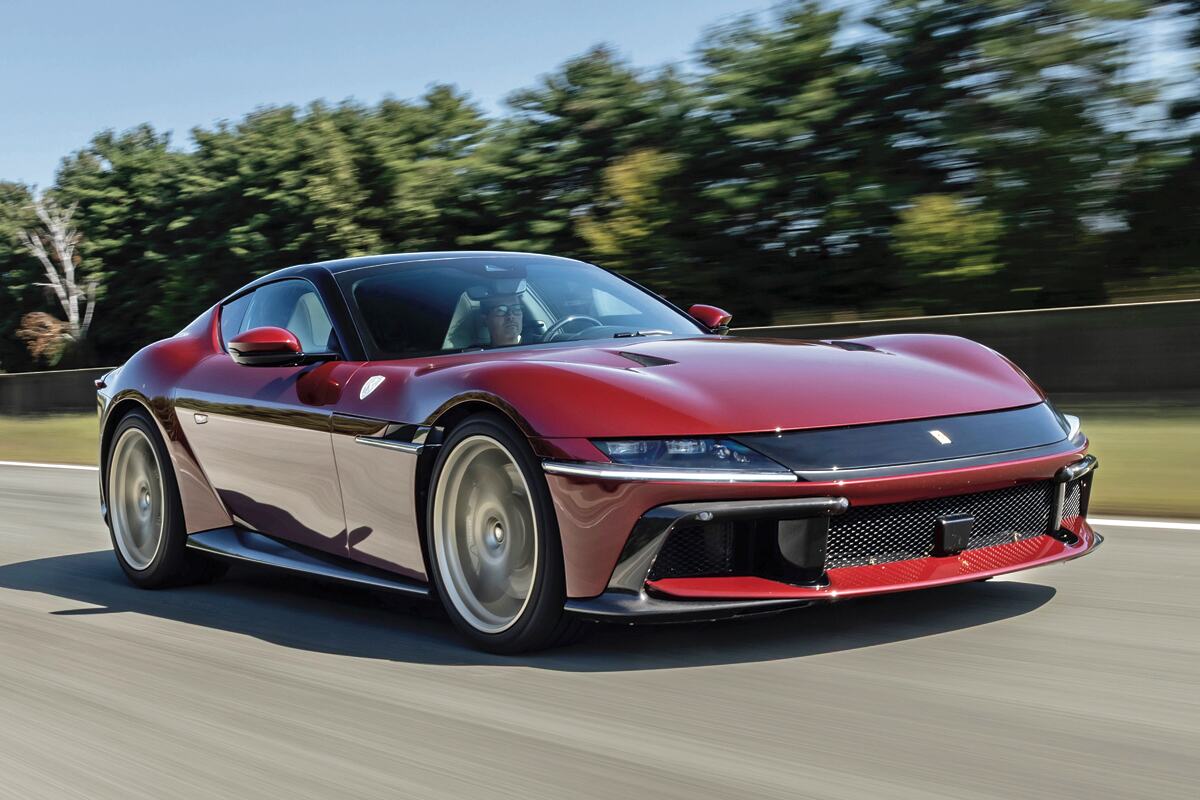
Funny how things change. Fifteen years ago, Ferrari could hardly persuade any of its customers to buy a car with a manual transmission. Today, it wants to charge them an extra $209,000 for one, and they’re lining up, checks in hand. Welcome to the world of the 12Cilindri Manuale, a stick-shift Ferrari that’s not quite as it seems, but one which might just revolutionize the entire enthusiast-car market.
The Manuale is a 12Cilindri with three pedals in the footwell and a classic open-gate shift quadrant on the console, Ferrari’s first for 14 years. It’s limited to 1,499 units and costs a hefty $670,000. A regular 12Cilindri looks like a bargain at $461,000.
I flew to Italy to row those gears, make sense of that premium, and learn why the Manuale’s not really a manual at all. But first, it’s worth considering how dramatically attitudes to transmissions have changed.
Maranello’s last manual-transmission cars were sold in 2012, by which time buyers overwhelmingly preferred the pricier F1 paddle-shift alternative. That was true even before the California introduced the vastly superior dual-clutch transmission in 2008. Only around 30 599 GTBs were built with the stick-shift, making that the last manual V12 Ferrari, while the final manual Ferrari of any kind was the California, of which only a handful got a stick.
Back then, Ferrari’s message was clear: paddles were faster, therefore paddles were better. It also helped cement a link with the company’s Formula 1 cars, which kicked off the paddle-shift trend in 1989. Today, though, manuals are highly prized, changing hands for far more than the two-pedal equivalents. At an RM Sotheby’s auction during the recent Monterey Car Week, a stick-shift F430 sold for $841,000!
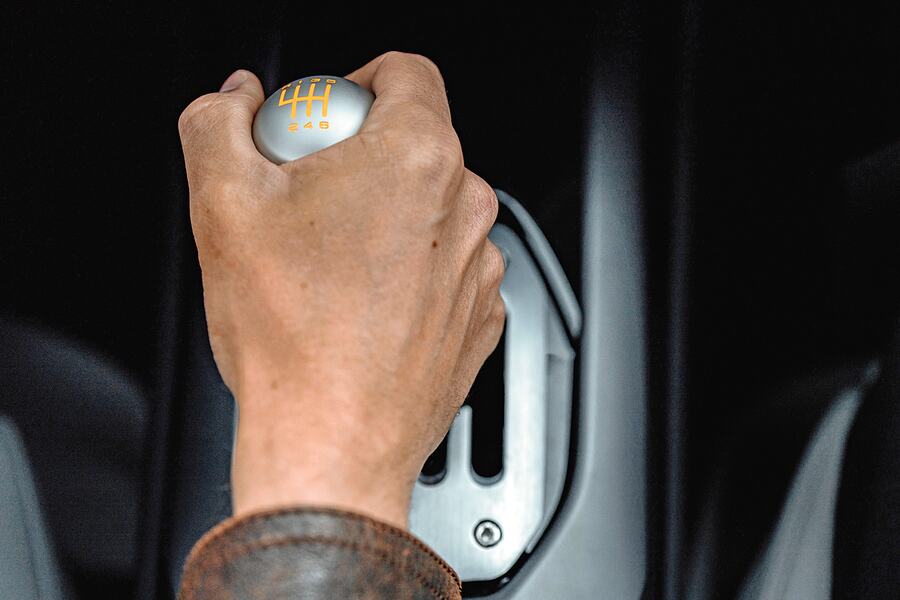
It’s not just buyers of used Ferraris who want manuals. In recent years, Maranello has fended off calls from new-car buyers for the stick-shift to return. Four years ago, it finally started to take those calls seriously, but not by simply slotting an old-fashioned manual transmission into the back of the 12Cilindri. Instead, Ferrari made its existing dual-clutch gearbox behave like a manual on-demand, in theory creating the perfect transmission.
The gorgeous aluminum ball sprouting from the center console isn’t physically connected to the gears, and the clutch pedal isn’t mechanically or hydraulically connected to the clutch. Instead, sensors detect what your right hand and left foot are doing, computers interpret those movements, and electronics tell the transmission what to do.
A fake manual, then? An expensive gimmick designed to cash in on nostalgia for the gated-shifter Ferraris that Maranello itself helped consign to history? That’s certainly one way of looking at it. But, after a morning throwing the Manuale around the old Alfa Romeo Balocco test track west of Milan, I’m convinced Maranello made the right choice.
FERRARI CALLS ITS INVENTION MANUALE BY-WIRE, and the principle isn’t so different from the electronic throttles we’ve accepted without much thought for decades. Two sensors monitor the lever position, while a solenoid can physically prevent you from selecting a gear if you haven’t pressed the clutch or are requesting a ratio the transmission won’t allow. Although the lever isn’t physically moving gears inside the transmission, what you feel through your palm really is mechanical resistance.
The gears are arranged in a conventional H-pattern, with reverse up and to the left. It’s the same layout Ferrari employed across all its manual road cars after switching from five to six gears, starting with the 456 GT in 1992. The relatively short lever (its length was dictated by the height of the console) is topped by a round, satin-finish aluminum knob. In default Automatic mode, the shift pattern on the top glows white. Dip the clutch pedal to activate the stick-shift function and it turns orange.
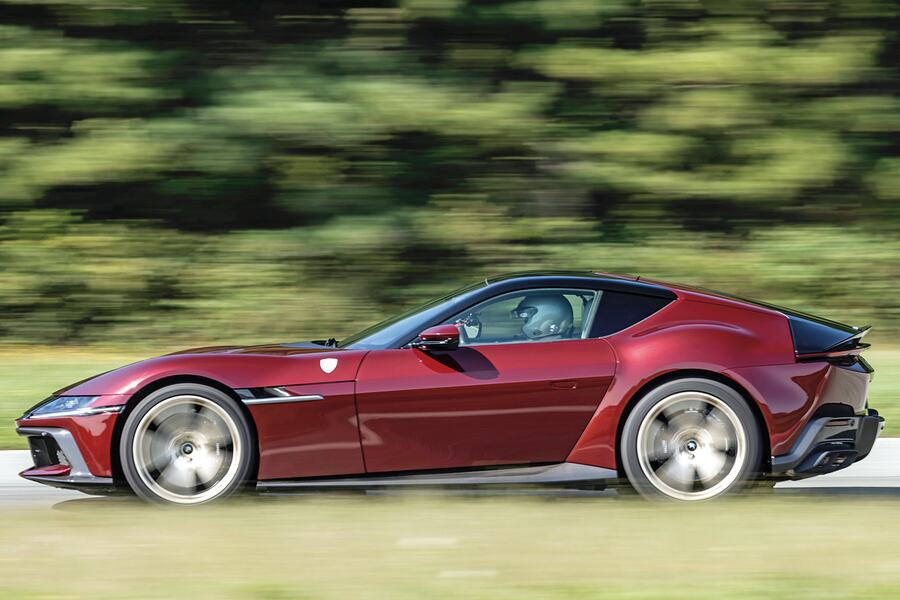
There are still eight ratios inside the dual-clutch transmission, all unchanged from the paddle-equipped car, but Ferrari only lets you access the first six manually. Seventh and eighth remain available in Automatic mode.
Gears one through three are similar to a 599’s, but fourth, fifth, and sixth are massively shorter, amplifying the effect of the 12Cilindri’s 207-hp advantage. Sixth gives just under 21 mph per 1,000 rpm (versus closer to 27 mph in the 599), and while the engine’s sky-high 9,500-rpm redline means it’ll still hit 190 mph, freeway cruising is going to be fairly busy. If you want to drop the revs, or are determined to test out the 211-mph top speed, you’ll need to press the D button on the console to activate Automatic mode.
You’ll also need to apply a reasonable amount of shove to move the gear lever, which has a short throw and absolutely no slack. Each movement across the open gate feels beautifully positive and comes with that classic clack-clack sound. The biggest surprise comes when you start shifting quickly. The Manuale requires far less concentration when you’re banging through the gears than a classic manual Ferrari, but somehow doesn’t feel sanitized because of it. You still feel like you’re performing the shift, rather than merely requesting one.
The clutch pedal is equally convincing. A sensor measures pedal position, electronics control the DCT’s clutch pack, and a spring, cam, and roller mechanism re-creates the load curve beneath your foot. It’s firmly weighted, with relatively short travel, but, like the shifter, isn’t excessively heavy.
More important, Ferrari hasn’t programmed out the possibility of screwing things up. You can even stall the Manuale, as my clumsiness proved when backing up to turn around with the parking brake still applied. Get the coordination between throttle and clutch wrong during an upshift and you’ll feel a jolt. Making every shift really smooth takes a little practice, just like it does with a conventional manual.
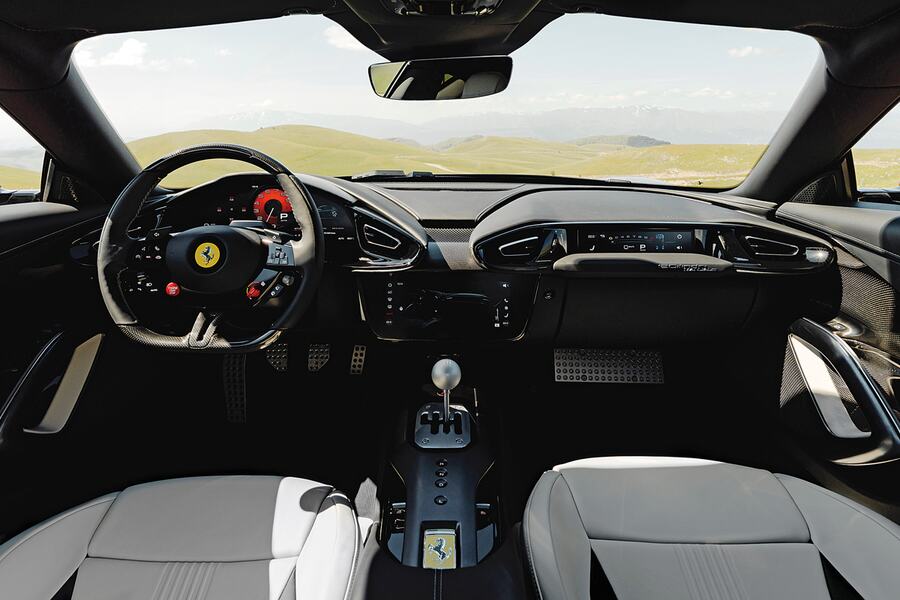
And that’s good, because eliminating every opportunity for failure would take away much of the satisfaction. Modern supercars make everyone look good: pull paddle, receive perfect shift. The Manuale puts some skill back into the equation, and rewards you for putting in the effort.
NOT ALL OF FERRARI’S DECISIONS make as much sense. There’s no automatic rev-matching function for downshifts, for instance. Engineers told me they considered the tech, but decided against it because it would feel too fake. Which seems like a very odd stance considering the clutch pedal and shifter are themselves telling porkies [i.e., “lies” in England’s Cockney rhyming slang—Ed.]. Why not provide rev-matching and let owners switch it off?
Fortunately, the pedals are beautifully positioned for heel-and-toe downshifts, though the V12 picks up revs so eagerly that you quickly learn to give the accelerator only the tiniest blip. And if Fred Astaire footwork isn’t your thing, don’t panic. The Ferrari test driver I rode with on a really hot lap before taking the wheel myself didn’t rev-match at all.
More annoying is that you can’t switch from Automatic to manual mode above 70 km/h (43 mph), a move Ferrari says it made for driver safety. Imagine cruising along a freeway in Auto, peeling onto a sweeping, deserted exit ramp, and deciding you fancy taking the reins yourself. First, though, you have to cut your pace in half before dipping the clutch will give you control—and because Ferrari has removed the shift paddles completely, you’re stuck with Automatic mode until then.
Admittedly, Ferrari’s Automatic mapping is hardly purgatory. It’s well-sorted, slurring the changes at cruising speeds in Comfort mode, then banging them home and downshifting exactly when you want when the steering wheel’s manettino is set to Sport or Race.
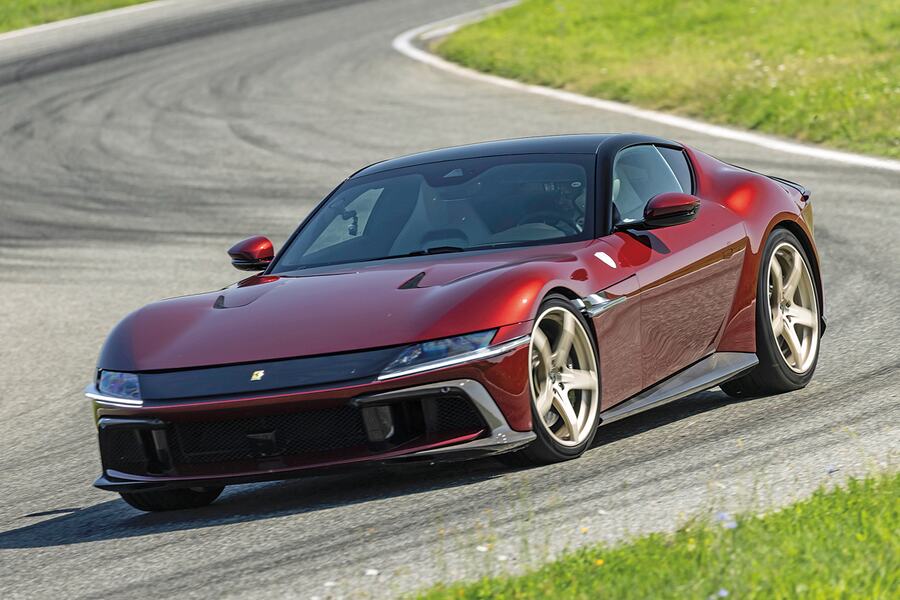
Everything else we already like about the regular 12Cilindri remains. The steering is tight, nicely weighted, and incredibly responsive. Electric power steering has taken plenty of flak over the years, but to my mind this system is better than the hydraulic racks in some older V12 Ferrari GTs. The rear-wheel steering is beautifully integrated, too, giving a far more natural cornering feel than the first Ferrari system I experienced in the F12tdf a decade ago.
And, oh my, that engine. I know we’re here to focus on Ferrari’s manual comeback, but that comeback is even sweeter when it’s hooked up to the greatest street engine in Maranello’s current arsenal. The naturally aspirated 6.5-liter V12 produces 819 bhp at 9,250 rpm and keeps spinning to 9,500. No turbos, no electrical assistance, all the noise. The V12 was already one of the main reasons to buy a 12Cilindri, and the manual interface fundamentally changes your relationship with it—for the better.
Ferrari says the Manuale can still hit 62 mph in 2.9 seconds when left in Automatic mode, matching the 11-pound-lighter regular car. The company doesn’t quote a figure when you’re changing gears yourself, and you can safely assume it’s slower, but who cares?
Redline the V12 in second, stomp the clutch, hurl the aluminum ball across the gate, feed the clutch back in, and chase the redline again in third. Then do it all over again into fourth. Suddenly, the loss of a few tenths seems laughably irrelevant.
At the same time, a 12Cilindri Manuale has never been more relevant, because it’s now a car that’s more fun to drive at sane speeds, when you’re just bimbling along in traffic, unable to tap into the car’s performance reserves.
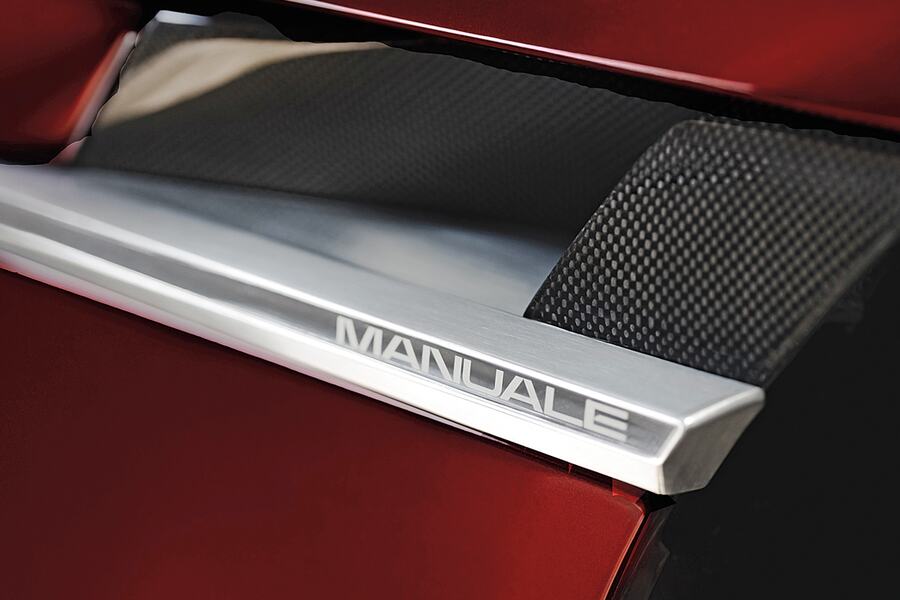
More than anything, you quickly stop thinking about whether the gearbox is “real.” The owner of a 308, F355, 550, or F40 might climb into a Manuale and tell you the shift action isn’t identical, and Ferrari would agree. Replicating an old gearbox was never the objective. Replicating the involvement and enjoyment was.
Plus, the Manuale can do something no traditional manual Ferrari can. Crawl into a Milan (or Miami) snarl-up after your Sunday morning blast, and you can switch it back into Automatic mode. Even the most committed stick-shift fanatic will have to admit a clutch pedal loses some of its romance when you’re halfway through an hour-long traffic jam.
That duality is why fitting a conventional manual transmission was never going to fly. Ferrari’s engineers rarely do backwards, even when its designers enjoy revisiting the past. A traditional stick-shift would have thrown away everything good about the DCT simply to re-create an old-school sensation. Manuale By-Wire instead uses new technology to restore what was lost without the penalty.
THE PRICE TAG IS HARDER TO RATIONALIZE, though that giant premium does at least include a dedicated Tailor Made specification. All 1,499 examples get special upholstery with six embossed stripes nodding to the six manual ratios, laser-etched or coin-effect fender shields, plus unique forged alloy wheels. One neat retro touch is the pin striping on the nose and tail inspired by the look of the early Plexiglas, fixed-headlight Daytonas.
A tiny proportion will also be available with a bare aluminum body. It isn’t literally naked—there’s clear lacquer over the metal, and the car I saw wore protective film—but it looks it, and Ferrari has cleverly developed a matching paint effect for plastic components such as the mirrors and bumpers. The labor involved means only a small number can be produced, and the price? Ferrari isn’t saying.
Ferrari isn’t saying much about the future of Manuale By-Wire, either. The system was developed entirely in-house, and the company holds patents on the technology, but nobody will confirm where it goes next.
A 12Cilindri Spider would seem an obvious candidate, and there’s no fundamental reason the system couldn’t work in something like the Purosangue. More intriguing, Ferrari engineers admit the concept could also be applied to hybrids like the 296. And now that Ferrari has demonstrated this kind of transmission is possible, you can bet Lamborghini and Porsche customers will be asking for one, too.
The Manuale isn’t perfect. The price premium is nuts, and the 43-mph restriction on engaging Manual mode is irritating. But the apparent contradiction at the heart of this car—using sensors, software, and an automatic gearbox to re-create an analog experience—matters far less from behind the wheel than it does on paper.
Because when that V12 is screaming towards 9,500 rpm, your left foot is hovering over the clutch, and your right hand is wrapped around an aluminum ball, ready to fire it through an open gate, you don’t care whether a metal rod physically connects that lever to a set of gears. So what if Ferrari technically hasn’t brought the manual gearbox back, after all? I say it’s done something better.