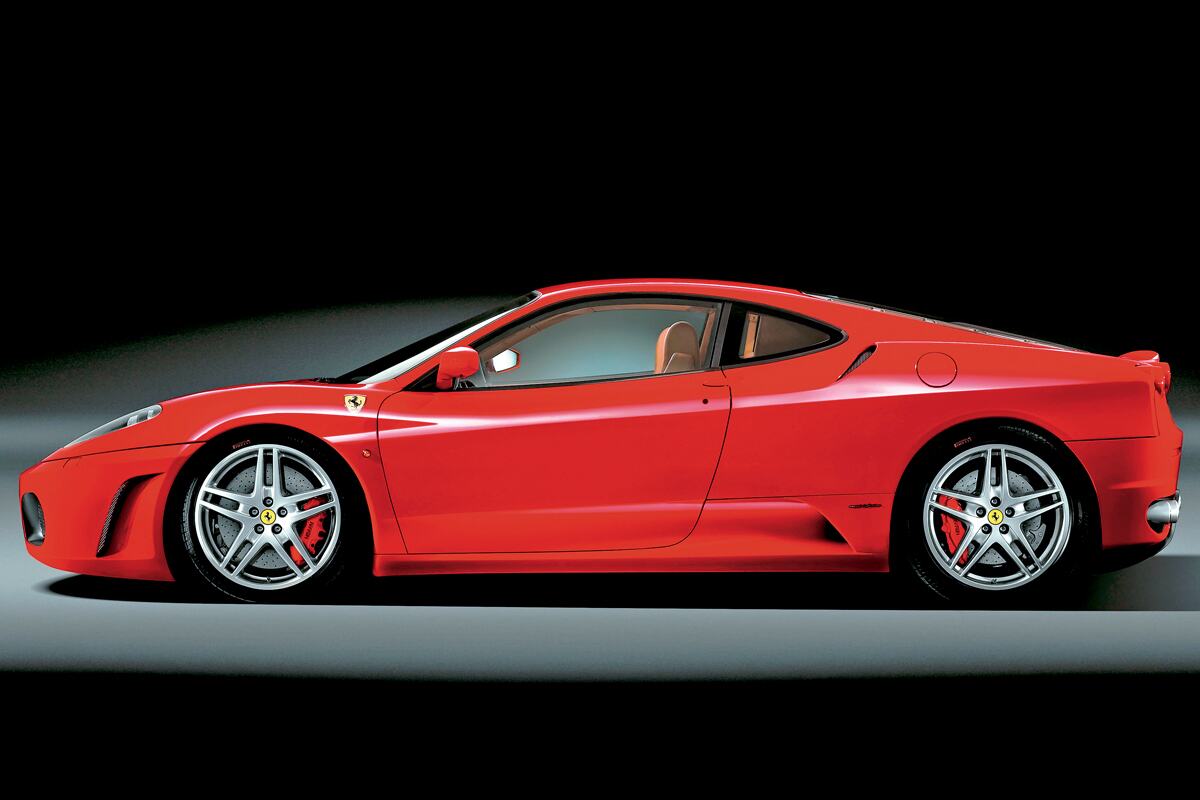
Given how thoroughly Ferrari rewrote its own sports-car cookbook with the 360 Modena, it was widely expected Maranello wouldn’t go overboard with its replacement. In one way, the company didn’t, as the F430 was clearly cooked using the 360’s basic recipe of all-aluminum construction and extensive wind tunnel testing, and the family connection between the two models was easy to see.
On the other hand, Ferrari significantly tweaked the recipe in terms of performance. Where the 360 delivered 400 horsepower (a 25-hp improvement over the preceding F355), the F430 stormed out of the stable with 490 ponies, courtesy of an all-new 4.3-liter V8. This 722-cc displacement increase also contributed to its 343 lb-ft of torque, a gain of 68 lb-ft, which in turn helped propel the F430 from 0-62 mph in 4 seconds and on to a top speed of 196 mph.
Also new were a pair of Formula 1-derived performance enhancers that have appeared on almost every model since: an electronically controlled differential and a steering wheel-mounted manettino. This then-revolutionary rotary switch allowed the driver to select from five dynamic modes—such as Wet, Sport, and Race—which delivered specific combinations of shock-absorber stiffness, traction-control intervention, shift speeds (on cars with the optional F1 transmission), and so forth. Further bolstering the car’s sporting credentials were a stiffer chassis, a faster-shifting F1 gearbox, optional carbon-ceramic brakes, more downforce without additional drag, and bigger wheels and tires.
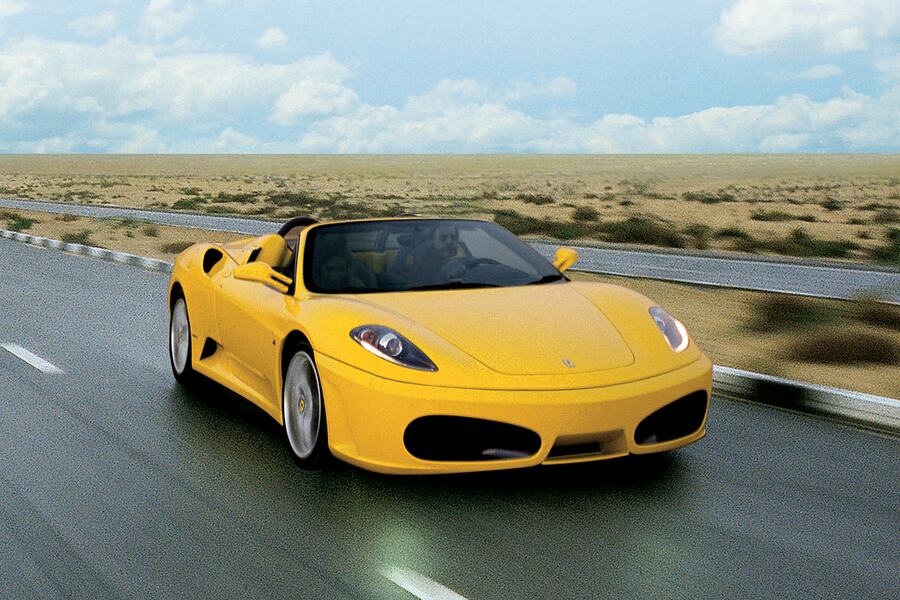
Ferrari produced four versions of the F430. The first, the berlinetta, was unveiled at the Paris Auto Show in 2004. The following year, a convertible version debuted. The only differences between berlinetta and Spider were the latter’s power soft top, exposed roll-over bars, and rear deck, which featured a glass window through which the engine could be admired.
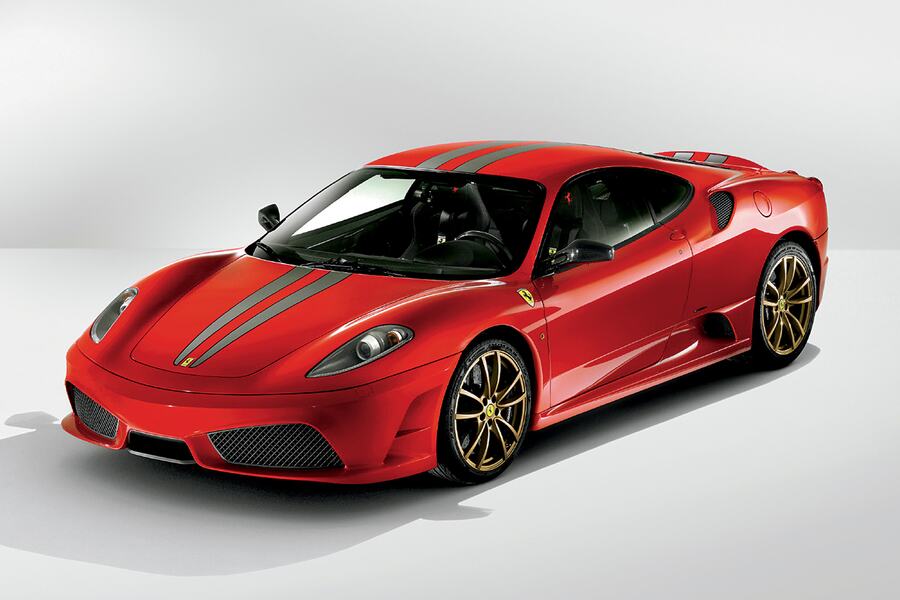
In 2007, Ferrari released a more sporting variant of the berlinetta called the 430 Scuderia. This model mimicked the earlier Challenge Stradale, with a stripped interior, more power, stiffer suspension and stickier tires, larger (standard) carbon-ceramic brakes, more downforce, less weight, and another innovation that has since become nearly ubiquitous: the “bumpy road” button, which softens the suspension independent of the manettino’s setting. The Scuderia sprinted to 62 mph in 3.6 seconds and lapped Ferrari’s Fiorano test track two seconds quicker than the F430. Finally, in 2008, came the Scuderia Spider 16M, a limited-production drop-top take on the 430 Scuderia.
While more expensive than its 360 predecessor, the F430 offers significantly better performance. If you have the budget, test-driving an F430 is a must.
Marketplace
THE F430 WAS AN INSTANT STAR when introduced at the 2004 Paris Motor Show. More aggressive looking, better handling, and much more powerful than the 360 it replaced, Ferrari’s latest-and-greatest V8-powered sports car built on the momentum created by its revolutionary predecessor, and its $225,000 base price (plus a typical options list that blew past $50,000) caused no concerns whatsoever in the boom years before the Great Recession of 2008.
A true sales success story, Ferrari built 16,750 F430 coupes and Spiders, along with another 1,800 or so 430 Scuderias and a claimed 499 Scuderia Spider 16Ms. Due to this generous production, the F430 eventually became just another fully depreciated exotic, with dozens listed on any given day on Cars.com, Cargurus, Bring a Trailer, the classified section of forza-mag.com, and many other publications and websites. By 2022, the F430 market had hit bottom—which was great news for buyers, who could purchase a fast, fun, reliable, and inexpensive-to-maintain Ferrari for under half of what it had cost new.
Today, however, we are firmly in F430 Bubble Land, thanks to the current AI boom and a new generation of younger buyers. As such, F430 prices have doubled, tripled, quadrupled, and even quintupled over the last few years. Where F430 coupes used to start at $75,000, they now go for a minimum of $175,000. Where Spider prices once topped out around $125,000, they now reach twice as much. As for the rarer Scuderias and 16Ms, what was very recently a high end of $175,000 or $200,000 has now very nearly hit $1,000,000!
Beyond the usual considerations such as the number and original cost of options, color combination, and deferred maintenance, there are two major factors that can further raise the price of an F430. As the last mid-engine V8 Ferrari offered with a gated manual shifter, but with less than 10 percent of production so equipped, stick-shift coupes and Spiders command a significant premium over their stablemates with the F1 transmission. (Aftermarket stick-shift conversions have become popular over the last few years, and these converted cars sell for around $25,000 more than an F1-equipped example.)
The second big factor in pricing is mileage. Most buyers of late-model Ferraris have a Freudian mindset: they want a low-mileage virgin. As a result, 2,000-mile examples sell for much more than 10,000-mile examples, while F430s with over 30,000 miles are a hard sell.
In dollar figures, expect to pay at least an additional $75,000 for a low-mileage, stick-shift F430 coupe or Spider. However, it’s important to note that low mileage can often equate to harder usage. Many owners keep their F430s for only two or three years, and such owners tend to drive their cars hard and put them away wet. These “Ferrari miles” are much harder on the equipment than, say, “Mercedes miles,” and so a higher-mileage, one-owner F430 is usually a better buy than a lower-mileage car with several owners.
As always with any Ferrari purchase, do your research, buy the best car you can afford, and have it inspected by a shop that knows the model inside and out. You want a car with a full, documented service history, a clean Carfax report, and a recent service by a qualified shop, even if it costs a little more. —Michael Sheehan
| Model | Low | High |
|---|---|---|
| F430 | $175,000 | $225,000 |
| F430 Spider | $175,000 | $250,000 |
| 430 Scuderia | $600,000 | $950,000 |
| Scuderia Spider 16M | $750,000 | $950,000 |
These prices are for fully serviced cars in good to great condition as of October 2026.
The Garage
PUT SIMPLY, the F430 is a great car, both to drive and from a maintenance-and-repair perspective. It was the first mid-engine Ferrari since the Dino 246 to use timing chains instead of rubber belts, eliminating the need for expensive cam-belt changes every five years. An annual service (which includes new accessory belts, air filters, and spark plugs, as well as changing the engine oil, coolant, and brake fluid) will typically cost less than $1,000—a serious bargain in the exotic-car world. That said, the perfect car doesn’t exist, so here are the most important things to watch out for and consider before purchasing an F430.
If you’re looking at a Spider, pay very close attention to its convertible top. While the design isn’t worse than that of many other modern convertibles, this electrohydraulic unit is very complicated and, if still original, roughly 20 years old. Servicing or repairing the top can be very expensive—Ferrari wants around $16,000 just for the fabric, but less-expensive aftermarket alternatives are available—so make sure the top opens and closes multiple times with no problems, aligns perfectly with the car’s body, and latches down with relative ease.
It’s not very common, but exhaust headers can develop cracks in the primary pipes and leak. The support brackets for the exhaust pipes at the back of the gearbox tended to crack and fail when these cars were still new, but most of these will have been replaced with upgraded units. If not, replacing the brackets isn’t that expensive—maybe $1,200 for the pair—but installing new headers will cost many multiples of that.
The rubber engine and transmission mounts will sag over time, allowing the drivetrain to vibrate against the chassis. The two engine mounts are easy to replace, but replacing the single transmission mount requires extensive disassembly at the back of the car. Replacing the trans mount when the transmission is out of the car for clutch service will reduce the labor cost significantly.
While generally very reliable, the various components of the F1 gear-shift and differential e-gear systems—such as the hydraulic pump, pump relay, and pressure accumulator—will eventually fail. One thing I advise prospective buyers to do is listen and make sure the pump isn’t running too frequently. It should run briefly at two-minute intervals with the key in the On position but the engine off, and at one-minute intervals with the engine running. If it kicks on too frequently, it’s usually caused by the e-diff solenoid valve not closing completely, which will cause the pump and relay to overheat and fail. Replacing a fried pump is an expensive repair, while minor issues (such as the relay, fuse, solenoid, pressure sensors, or accumulator) might run in $1,500-2,000 range.
The F430’s oil and water pump is one combined assembly, which means that any single failed component requires replacing the entire unit. Water leaks are the most common issue, so inspect the pump if you can. A green or blue dried coolant stain around the weep hole is acceptable, but a drip (or worse) most likely means a new pump is in order. One tip: Rebuilding the original pump instead of buying a new one will cut the repair bill significantly.
The electric solenoids that activate the camshaft variators (the hardware that constantly adjusts the valve timing) sometimes wick oil up the wiring harness. Over time, this will overheat the solenoid and melt the electrical connector. New solenoids from Ferrari are apparently in short supply, but Maserati solenoids (with the same part number) are available and cost less. You’ll want to replace all of the solenoids at once, in order to avoid the repeat labor charges when the next one fails, and it’s very likely the solenoid wiring harnesses will also need to be repaired. While you’re in there, I’d advise adding additional layers of heat insulation, as well.
Paddle shifters are fast and easy to use, but F1 clutch life often isn’t as long as with a traditional stick-shift. The problem is that the F1 system allows too much clutch slip in first and reverse. Luckily, a technician with the right computer scan tool can check the remaining clutch life—a real advantage when replacing the clutch, flywheel, and bearings will likely run into five figures.
If an F430’s air-conditioning system doesn’t work, it’s often caused by a rubber O-ring failing inside the compressor. Unfortunately, the fix is to replace the entire compressor. (Another possible cause is that the HVAC panel’s truly silly “Off” button is pushed in. The button must be in its out position for the A/C to work!)
The F430 was one of the first Ferraris offered with optional carbon-ceramic brakes. These work amazingly well, but cost $25,000-30,000 to replace all four corners when they wear out. Note that these exotic brake rotors need to be removed and weighed, rather than just measuring the thickness, to determine wear. —Wil de Groot
On The Road
The F430 has long been one of our favorite Ferraris. Here’s some of what we’ve said about the model over the years.
As expected, the F430’s 490-hp V8 is eager to rev. I initially short-shift at 4,000 or 5,000 rpm, reveling in the torquey mid-range, and still knowing that a healthy 3,500 more revs are available as desired. As the needle climbs past 6,000 rpm, I appreciate anew the engine’s lack of inertia, as well as the increasing intensity of the exhaust note.
The V8, and thus the car, reacts the moment I press the throttle; there is no tardiness in the drivetrain. The higher the revs, the quicker everything responds, the analog tachometer a visual manifestation of the engine’s grin-inducing talents as the needle swings past the 12 o’clock mark.
While the manual gearbox isn’t as fast as the F1 system, the standard shifter still allows me to make quick changes, undoubtedly helped by the open metal gate. I’m never in doubt regarding the feel or position of the shiny, round ball, nor how far I should push or pull the lever—it all comes naturally and instinctively.
Although the F430 is now 15 years old [in 2020], it still delivers an intoxicating level of all-around performance, along with stellar balance. It’s never scary nor is it silly-fast like most modern supercars, yet it provides serious driving satisfaction.
“Driver’s Choice,” FORZA #187
Very soon, I’m tackling a seemingly never-ending series of switchbacks in the Pocol pass, the first of four mountain passes on the route. The F430 Spider wants to understeer through some of the tighter hairpins, but a quick push of the throttle neutralizes things. With the steering wheel-mounted manettino set to Race mode, the car’s rear end gently swings out under power. Actually, the Ferrari moves around quite a bit underneath me, but it’s a friendly, involving motion rather than an alarming one.
The Pordoi marks the high point of the Coppa d’Oro route, at 8,815 feet, and my ears pop twice by the time I reach the bottom of the pass. This is a fearsome test of the F430’s brakes, but there’s no hint of them being stressed. More than any other experience, this multi-mile downhill sprint makes me a believer in the high-tech carbon-ceramic stoppers that are now standard across Maranello’s model lineup.
The Ferrari is an impressively livable cruiser. The seats are both comfortable and supportive, the ride quality in Sport mode is perfectly acceptable even over the occasional pothole, and, with the convertible top down, the air passes cleanly over the cockpit, gently tugging at my hair. The only hint of the car’s normally high-strung nature is the constant engine and exhaust noise. But since I’m splitting my time between running flat-out, when the noise is appreciated, and creeping along, when it’s barely noticeable, it’s not a distraction.
“Golden Years,” FORZA #89
The optional shift lights on the Scuderia’s steering wheel allow me to keep my eyes on the road but still shift at the right moment. When the going gets rough, all it takes is a push of a button in the center console to change the suspension to its soft setting, after which the car easily absorbs ridges and bumps in the crumbling tarmac. (In Sport or Race mode with its suspension set to soft, the 430 Scuderia is perfectly comfortable on real-world roads; the default suspension setting, on the other hand, is best left for glass-smooth asphalt.)
Thanks to the car’s ease of use, I can safely zip along at a considerable clip, able to focus my attention on braking points and apexes rather than rowing the gearbox and watching the tach. This lack of effort doesn’t translate into a disconnected feeling, however; there’s plenty of information flowing in through the steering wheel, brake pedal, and especially the seat of my pants. Likewise, I usually don’t feel the car’s electronic systems working away beneath me—it’s a largely invisible process.
Best of all, driving the 430 Scuderia is exhilarating. The experience starts with the engine. When I get on the gas coming out of a corner, the V8 delivers noticeably more grunt and the deeper, more bellicose exhaust note fills the cockpit. The aural symphony begins at 3,200 rpm, when valves open in the exhaust to reduce back pressure, and the spine-
tingling howl increases in pitch and intensity as the tachometer needle whips around to the 8,640-rpm redline.
The 430 Scuderia turns in with astonishing quickness and precision—more so than the F430—but it’s never darty. The grip seems endless, yet the car is also very playful. Sprinting uphill through a series of hairpin corners, I can smoothly slide the back end out under power; do it really aggressively and the Scuderia will slither sideways with its V8 howling and bouncing off the rev limiter.
“Family Feud,” FORZA #82