The storied Superamerica name returned to the Ferrari lineup in 2005, when it appeared on a limited-production 575M with an innovative rotating roof. A few years earlier, however, the name had been proposed for a very different Ferrari, one that, had it come to fruition, would have ignited a storm of controversy.
The stillborn Superamerica’s story begins with the I.DE.A Institute of Moncalieri, Italy, a dynamic styling and engineering organization led by the astute, kind, and impeccably mannered Franco Mantegazza. I.DE.A was particularly active on Fiat Group projects throughout the 1980s, and while its most notable contributions were the Fiat Tipo and the Alfa Romeo 155 family, its involvement extended, to varying degrees, across most programs originating in Mirafiori.
Most relevant here was I.DE.A’s work on the facelift, retractable rear wing (a market first), and certain engineering aspects of the Lancia Thema 8.32, the Ferrari-engined flagship unveiled to the world at the 1986 Turin Motor Show. [We drove one in issue #223’s “Fantastic Voyage.”—Ed.] It was no easy marriage; Ferrari’s 2.9-liter V8, a marginally reduced-capacity version of the engine found in the 328 GTB/GTS and the 3.2 Mondial, had to be compactly installed beneath the Thema’s front hood. Yet the neat, elegant saloon absorbed the Maranello engine with surprising poise, even if its original engineering balance inevitably suffered.
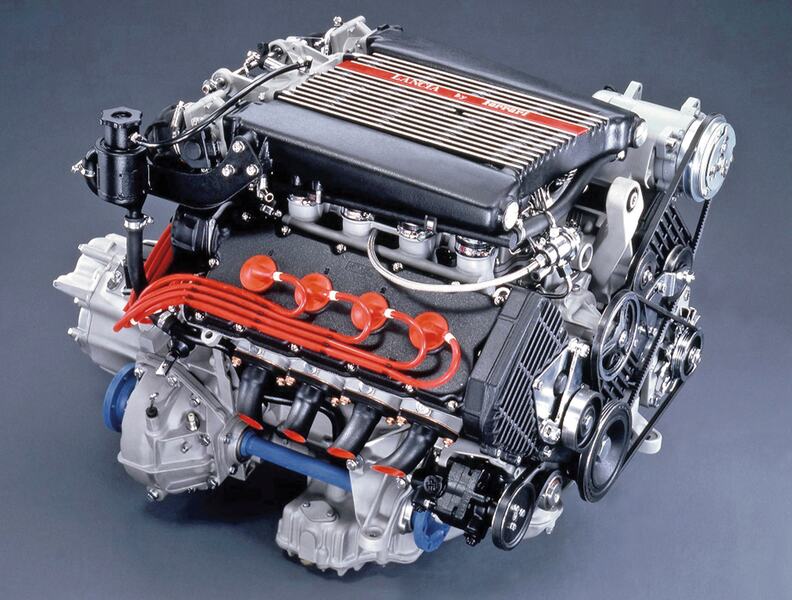
Lancia Thema 8.32’s Ferrari engine.
The Thema 8.32 project benefitted from the steadfast support of Fiat Auto’s Managing Director, Vittorio Ghidella, who served simultaneously as the Chairman of Ferrari. A man of rare vision and decisive, far-reaching action, Ghidella’s conception of Ferrari’s future was guided less by convention than by a bold and luminous sense of possibility. Just a year earlier, as rumors swirled about the possible production of the Testarossa-powered four-door Pinin sedan—itself, to many, an almost heretical Ferrari—and spy shots of running prototypes circulated widely, he seemed more than willing to fuel speculation, entertaining the press with carefully ambiguous remarks.
For example, at the May 1985 presentation of the Fiat Uno Turbo hatchback in Rio de Janeiro, Ghidella talked about advanced studies and potential applications for a four-wheel-drive project. Internally designated F117, this initiative was entrusted to Ferrari Engineering, led by esteemed racing engineer Mauro Forghieri, who had been moved from his usual spot inside the Gestione Sportiva (then under Harvey Postlethwaite) to develop the consultancy service.
By that September, though, for reasons still undisclosed, Ghidella announced the cancellation of the Pinin, which had been pushed for years by Ferrari’s General Director, Giovanni Battista Razelli. It was one of the models purportedly slated to receive Forghieri’s all-wheel-drive system.
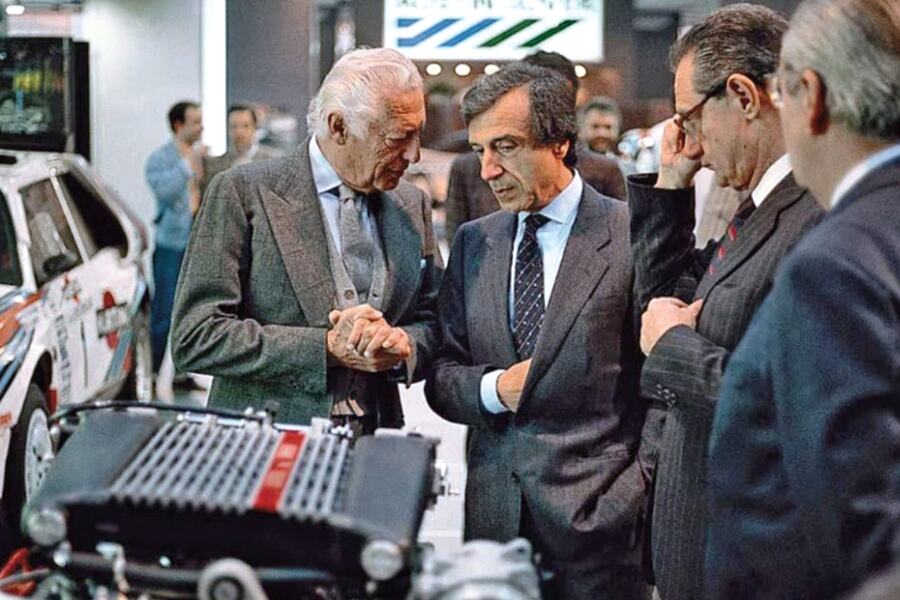
Fiat patriarch Gianni Agnelli (at left) talking with Managing Director Vittorio Ghidella.
Then, in April ’86, just when the purists thought their voices had finally been heard, the Thema 8.32 arrived. Was it conceived as a response to the Pinin’s cancellation, or did it arise for entirely different reasons, such as being a cheaper, more pragmatic way than the Pinin to bring a four-door “Ferrari” to market? To this day, the truth remains unknown.
What we do know is the multitude of magazine covers, headlines, and praise the Lancia-Ferrari initially received—until driving tests revealed the weakness that analysts had long predicted: its front-wheel-drive platform was no match for the 2.9-liter Ferrari V8’s 215 hp and 210 lb-ft of torque.
The next question was obvious: Could all-wheel drive remedy the problem? It was widely speculated that it might. However, it would ultimately be Lancia’s expertise with the Delta Integrale that came to the rescue, not Ferrari’s own system developed by Forghieri’s team.
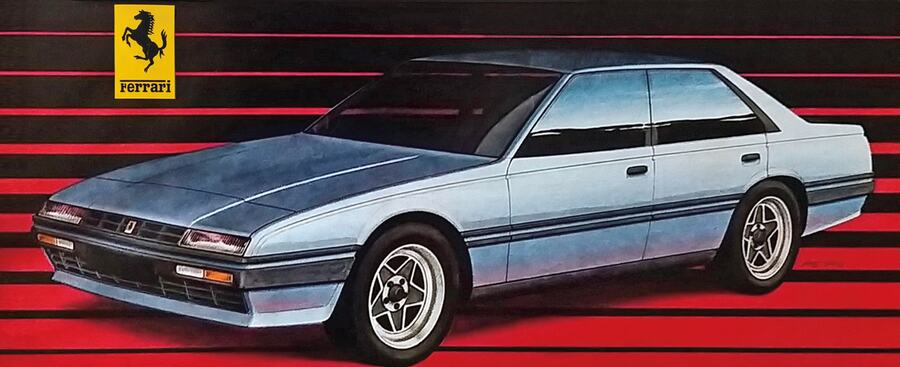
Pinin four-door project was cancelled in late 1985.
Running prototypes of the Thema-Ferrari Quattro Ruote Motrici were in the works by late 1987 and spotted in action during 1988. A viscous central differential combined with a Torsen unit at the rear axle seemed the obvious choice, but the idea never progressed beyond the prototype stage.
THIS BRINGS US TO THE GENESIS of the Superamerica. Although I.DE.A had helped create the Thema 8.32, at the time it seemed almost shocking that a Ferrari project would not be entrusted to Maranello’s nearly lifelong partner, Pininfarina. But I.DE.A had already designed one Ferrari—the PPG-financed Mondial-based Indy Car pace car ["Stranger in a Strange Land,” FORZA #225]—and, in 1987, chief designer Ercole Spada was handed the reins of this second Maranello project.
As dictated by Ghidella, the fresh and distinctive 2+2 Superamerica would be based on the unaltered underpinnings of the front-wheel-drive (!) Lancia Thema 8.32, and built in both open and closed versions. The very idea was enough to spark fierce debate—and more than a little outrage—yet there was undeniably some clever, coherent thinking behind the proposal. Still, one cannot help but suspect that if Il Commendatore had retained the authority he once wielded, he would never have approved such a departure from orthodoxy!
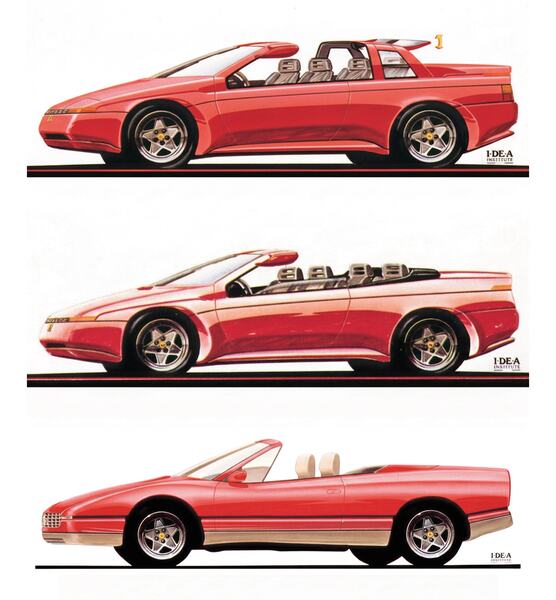
Three I.DE.A concepts for the Superamerica convertible.
Unlike the PPG Pace Car, which remained an I.DE.A exclusive, Ferrari did bring Pininfarina into the Superamerica project, although only a handful of tentative renderings of its vision ever made it into the public eye. And while the Superamerica briefly overlapped with the Pace Car inside of I.DE.A, the latter began to receive serious attention only after the more strategically significant Superamerica had been fully defined.
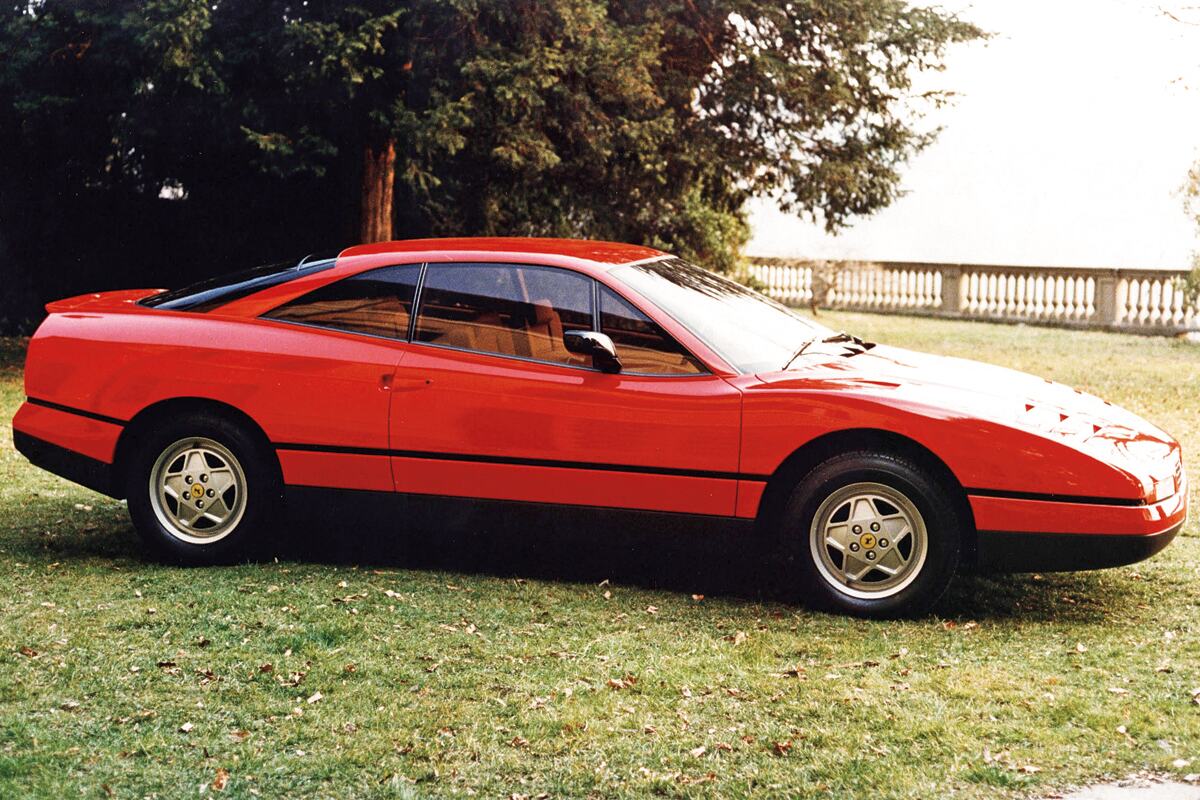
As with the Pace Car, Ercole Spada’s right-hand man, Justyn Norek, supervised the styling development, after which, as with the Pace Car, Spada’s personal proposal emerged as the winning theme. The new Superamerica wasn’t vastly different in appearance from the more slender Mondial 2+2, which it was effectively intended to replace, but it did not lack grace or elegance. It also felt large enough for American customers’ demands, although it arguably fell short of true Ferrari attitude and character.
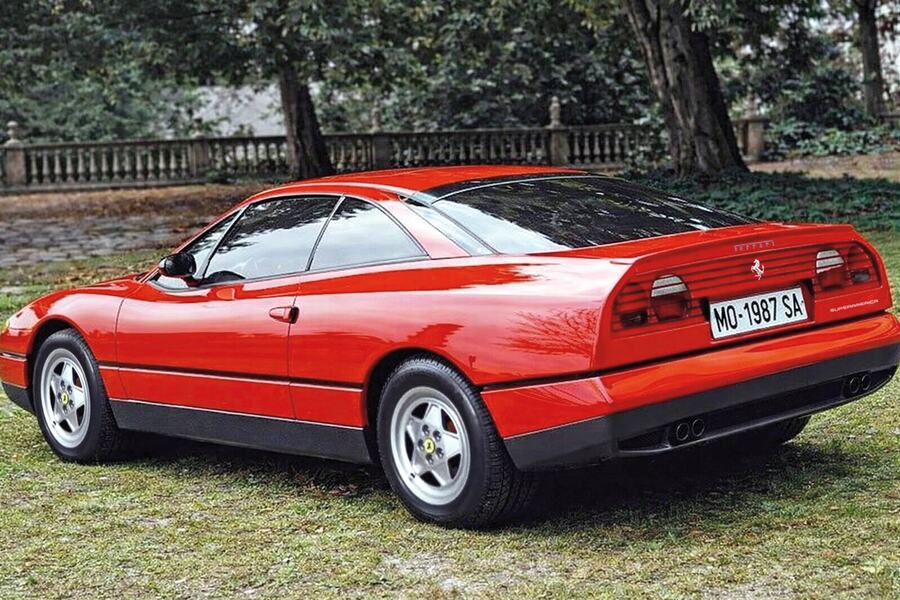
Strikingly, given the very high costs involved, the Superamerica project produced not only the customary solid full-size epowood-and-plaster styling model, but also a full-size semi-operational demonstrator, complete with opening doors and hoods, a fully finished interior (undoubtedly the most beautiful aspect of the car) by ex-Renault designer François Lampreia that was further enhanced by the remarkable steering wheel designed by Pablo Hohenlohe, along with suspension, engine, and other mechanical components, albeit inactive.
The Superamerica’s fate was inseparable from that of Ghidella. And with the executive burdened with far more pressing responsibilities—most notably the integration of Alfa Romeo into the Fiat Group—a low-volume Ferrari, however prestigious, could hardly command his sustained attention. As a result, it became increasingly difficult for him to personally supervise and champion his Ferrari initiative at I.DE.A, although he was certainly entitled to do so.
Since assuming leadership of Fiat Auto in 1979, Ghidella had transformed the company into Europe’s market-share leader, steered it through a quality crisis, and elevated productivity and profitability to unprecedented levels. In addition, he supposedly owned 40 percent of Ferrari—the stake Fiat was said to have purchased from Enzo Ferrari years before his death—bringing Fiat’s total ownership to 90 percent. (Ghidella had reportedly held this stake for roughly six years, having acquired it directly from Enzo Ferrari, who requested that the shares remain in his name to maintain the appearance of nominal control until his passing.) Within the boundaries of his 40-percent stake, Ghidella strove to bring innovative ideas to fruition for the Cavallino brand, but opposition and circumstances proved too entrenched to overcome.
After years of internal battles with Cesare Romiti, the pragmatic, hard-nosed Managing Director of the Fiat Group, Ghidella resigned from Fiat on November 25, 1988. His stake in Ferrari was sold to Fiat, and he departed for Ford. There, he would assume an advisory role to Philip Benton (soon to become President and Chief Operating Officer of Ford Motor Company) with the ambitious aim of orchestrating the purchase of Maserati from Alejandro de Tomaso and Fiat. But it was not meant to be.
Nor, it turned out, was the Superamerica. From the moment Ghidella left Fiat, the Superamerica project ceased to be an active endeavor. It instead became a small, lost chapter of Ferrari history, preserved today only in a few period photographs of its now-vanished full-size mock-up, resting on the green lawns of the romantic I.DE.A headquarters.