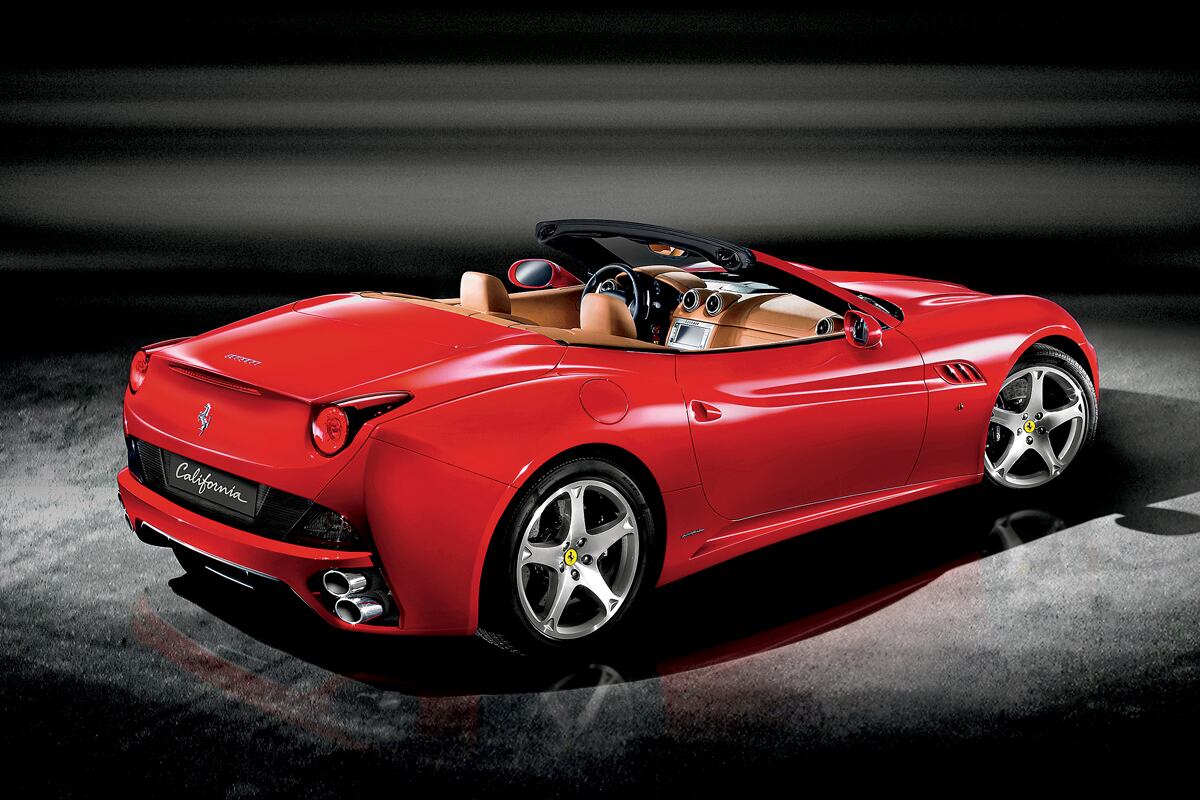
At the 2008 Paris Auto Show, Ferrari introduced an all-new hardtop convertible: the California. The company developed the V8-powered GT to attract a new customer, one who might otherwise buy a luxury convertible from Aston Martin, Bentley, or Mercedes.
In trying to widen its reach, Ferrari infuriated a very vocal segment of its fan base. In fact, the company was deluged by criticism from all sides, accused of everything from selling out its heritage (the new car’s name and retro hood scoop paid homage to the legendary California Spyder), poor design (particularly the plump rear end required to hide the folded metal roof), and the new model’s intended “non-enthusiast” buyer. There was even a rumor that the car had originally been designed for Maserati.
All those complaints aside, the California was a real Ferrari where it counted. Like its stablemates, the car featured all-aluminum construction, a flat-plane crankshaft, and carbon-ceramic brakes. Despite being the least-powerful pony in the lineup, it was the most sophisticated, being the first model to receive a seven-speed dual-clutch gearbox, multi-link rear suspension, and direct fuel injection. Other firsts included a front-mid-mounted V8 engine, front and rear subframes to carry the mechanical components, and, of course, that exotic roof, which raised and lowered in just 14 seconds.
Then, once people had a chance to drive the California, they discovered it wasn’t bad at all. The automotive press almost universally praised the newest Prancing Horse’s speed, refinement, comfort, and practicality. The vestigial rear seats—so small that Ferrari described the car’s layout as
2+ rather than 2+2—weren’t sized for real people but
proved excellent for additional storage (as did an optional
rear bench). To CEO Luca di Montezemolo’s delight, the car captured its hoped-for conquest audience: Seven out of ten California buyers were new to the marque.
At the 2012 Geneva Auto Show, Ferrari unveiled the mechanically updated California 30. (Though unofficial, the “30” moniker is used by the factory and dealers alike.) Compared to the original, the Cal 30 produced 30 additional horsepower and weighed 30 fewer kilograms. Also new, and popular, was the optional Handling Speciale package, which improved the car’s reflexes with little penalty in ride quality.
Two years later, Ferrari unveiled a more serious version: the California T. Beyond its more aggressive bodywork (including a noticeably slimmer rear end) and revised interior, the T boasted a twin-turbo V8—the first turbocharged engine to come out of Maranello since the F40. More significant than the 70-hp gain over the Cal 30 was a 184 lb-ft increase in torque. Despite this boost in performance, the Cal T proved to be a better, more comfortable touring machine than its predecessors.
The California quickly became Ferrari’s best-selling model. As a result, used examples are both plentiful and affordable today. Add in the car’s impressive reliability, performance, and all-around usability, and this is one Ferrari that’s easy to recommend.
Marketplace
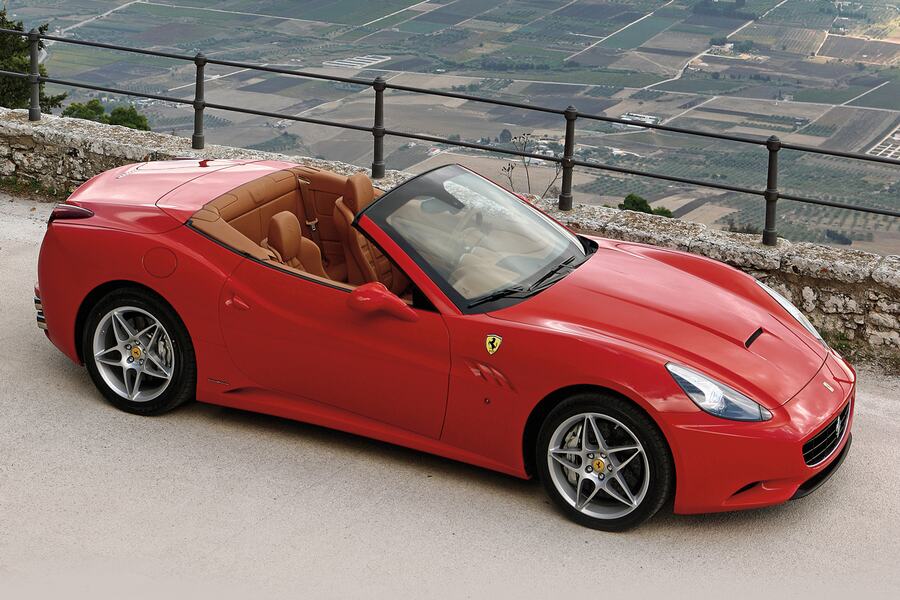
WITH THE 2008 CALIFORNIA, Ferrari designed its first true mass-market, high-volume model. Marketed at a sub-$200,000 price point, the California was aimed squarely at buyers who were more attracted to luxury and usability than ultimate performance. As the company’s Director of Product Development, Massimo Fumarola, put it, “California buyers like to go away for the weekend. They have kids, and they like the versatility of the car. They are looking for a sports car, but the F430 is too much.”
The California eventually became the success Ferrari hoped for, but it wasn’t a smooth ride. The model was introduced just as the economy tanked (remember Lehman Brothers?), the long list of ubiquitous options pushed window stickers well above $200,000, and many customers were disappointed to discover the rear seats were pretty much useless for human habitation. (On the other hand, buyers loved the comfortable, form-fitting front seats and the folding metal roof.)
Total sales over the first three years were only around 8,000 units, but production climbed as the economy recovered, particularly when Ferrari introduced the lighter, more powerful California 30 in 2012. In 2014, Ferrari upped the ante once again with the California T, its first turbocharged road car since the F40—and the T delivered 80 hp more, and was a half-second quicker from rest to 60 mph, than the F40!
With total production of all three variants reaching roughly 17,300 cars, the California was ultimately a major marketing coup for the company. Production continued until the debut of the all-new Portofino in 2018.
Thanks to the miracle of depreciation, the arrival of a newer and faster model every few years, and numerous cars for sale every day, today’s market tilts firmly in the buyer’s favor. Californias are user- and wallet-friendly, with first-generation models with 15,000 miles starting as low as $75,000. Prices for the newer Cal 30 start around $85,000, while a 15,000-mile Cal T will set you back at least $100,000. Higher-mileage examples—of which there are many, thanks to the model’s reliability and daily usability—are user-friendly, high-performance bargains.
Whichever version you’re interested in, take your time and find the right example. With hundreds for sale at any given time, you can afford to be picky. —Michael Sheehan
| Model | Low | High |
|---|---|---|
| California | $70,000 | $85,000 |
| California 30 | $85,000 | $100,000 |
| California T | $90,000 | $125,000 |
These prices are for nicely optioned, well documented, and fully serviced cars in good to great condition as of August 2026.
The Garage
AFTER SPEAKING with service managers at several authorized Ferrari dealers, as well as a few mechanics at independent shops, the consensus on all the California variants is that they are practically bulletproof. How else to describe a car whose most common problem is a dead battery caused by infrequent use?
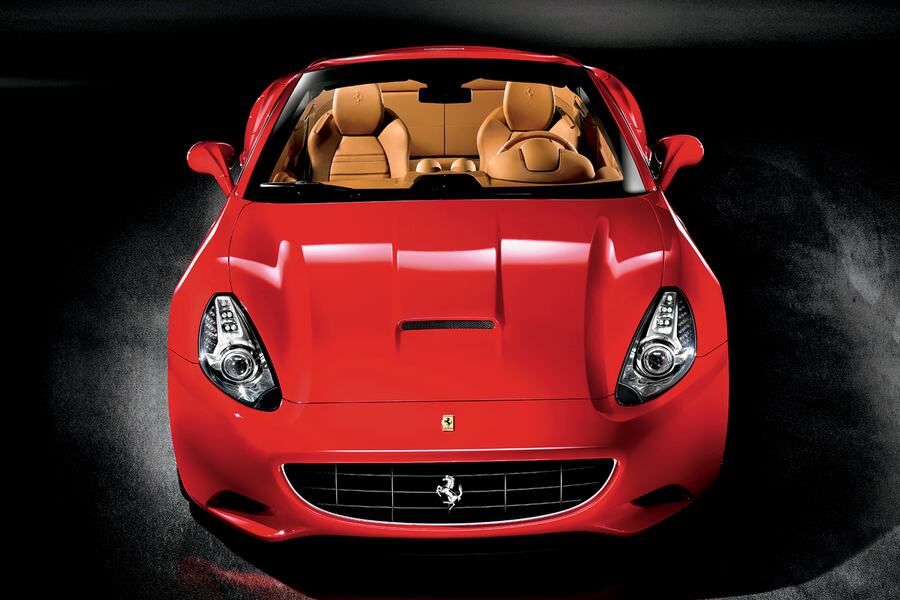
Overall, the California is as rugged and reliable as one can hope for in a low-volume exotic. As with any such high-tech car produced in small numbers, however, isolated problems do arise. These most often take the form of electrical gremlins, such as random warning lights and dead fan relays, as well as the occasional failed instrument panel.
Early examples had a handful of more serious teething issues, but these should have been fixed under warranty long ago. As with other Ferraris of this era, the leather on the dash and binnacle will shrink if the car regularly sits in the sun, and, inexplicably, the dreaded sticky-switches problem remains unresolved.
Servicing costs are pretty painless for an exotic. The once-dreaded cam-belt replacement is now a thing of the past, as both the normally aspirated and turbocharged V8s utilize a timing chain. However, Ferrari’s new-car and extra-cost extended warranties have by now expired, so expensive repairs can arise.
The priciest often-seen problems concern the seven-speed dual-clutch transaxle (which was also used on the 458, 488, FF, and F12). With age and miles, the DCT is prone to internal oil leaks, as well as solenoid and sensor failures—and there’s no lack of sensors that can fail. Official Ferrari dealers will replace the transaxle for around $55,000, but a qualified independent shop can rebuild the unit with all-new seals, sensors, and bearings for $20,000-30,000. If new wet clutches are needed, add another $13,000.
Fair warning: While the folding metal roof is a wonder of mechanical magic to see in action, before lowering it you must prepare the trunk. This means putting the interior cover into place and making sure everything fits inside the allowable area. Some owners have damaged their car’s roof by lowering it when an object was sticking through the trunk pass-through, or simply when the trunk was too full. —Michael Sheehan
On The Road
It’s no sports car, but the California still delivers a fantastic driving experience. Here’s some of what we said about the model when it was still in production.
On the road, the new California is a marvel of docility and civility, completely at ease commuting through stop-and-go traffic, running mundane daily chores, or cruising down the highway. But when I get on it in anger, the car shoots deep into triple-digit speeds with ease.
The California is deceptively quick, so seamless is its acceleration. The V8 pulls with one long elastic whoosh of thrust to its 8,000-rpm redline; there is no hint of peakiness.
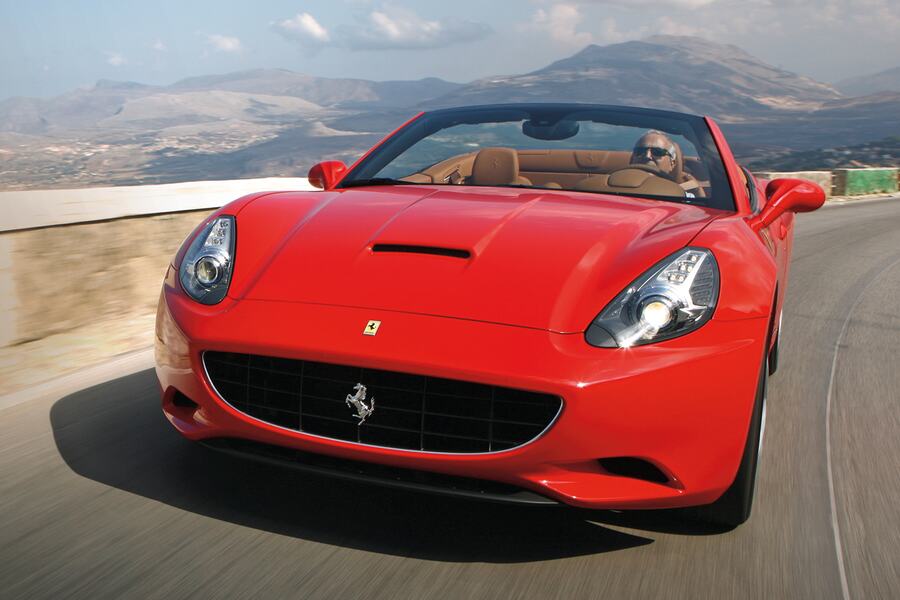
My favorite aspect is probably the steering. The turning radius is tight and turn-in is superbly crisp, yet the Ferrari never feels nervous regardless of speed.
Indeed, the California always feels completely unflappable. Whether I’m going fast or slow, everything remains placid and serene, with the world and its troubles held at arm’s length. This is quite likely the best all-around car Ferrari has ever made, a perfect successor to the 330 GTC, 365 GTC/4, Mondial t, and 456. It is truly brilliant in its own unique way.
“Generational Divide,” FORZA #110
Sure, a 30-hp boost is nice, but that’s an increase of less than 7 percent. And while I’d like to lose the same 30 kilograms, the California 30 still tips the scales at nearly 3,800 pounds.
So do these relatively minor changes add up to a more engaging Ferrari? Oh, yes. By a lot.
The California 30 feels noticeably sharper when I get on the gas compared to the original. The two tenths of a second drop in 0-62 mph time actually represents a major improvement in terms of acceleration; this car is seriously quick. Ferrari claims a near 200-mph top speed, and while I didn’t try that out, I can report that third gear is always good for a quick-and-easy, and truly glorious-sounding, 120 mph.
In terms of handling, the Handling Speciale setup really delivers the goods. Ferrari’s claim of reduced body roll is spot-on, and the California 30 handles more confidently than the first-gen car. There’s also a bit more steering feedback and road feel than before. The car lives to run, loves to attack, and does a far better job of telling you what it’s up to than its predecessor.
“Going back to Cali,” FORZA #127
It’s the torque transformation that’s the big story here, the total now standing at 556 lb-ft, up from 372 lb-ft before. In reality, it’s a little more complicated than that, because the full 556 lb-ft is only available in the seventh ratio of the mandatory dual-clutch transmission. Punch the right pedal in any of the first three gears, and you’ll have a maximum of 450 lb-ft to play with, which climbs only to 479 lb-ft in sixth.
The turbocharged V8’s extra torque makes itself felt as I cruise around Tuscany at part throttle, dispatching the gentle inclines woven into the rolling fields with far fewer gear changes and much greater ease than in the normally aspirated California 30. And when I push the throttle wide open, a very different picture emerges; the F1 transmission snaps down three gears in Automatic mode, the engine note hardens, and, rather than plateauing, the kick in the back just keeps kicking. Although the throttle response is instant, I can feel a slight delay as the turbos spool up—but it’s a brief pause, and from that moment on, all hell breaks loose.
Baby of the Ferrari range the T may be, but it’s a shockingly quick car.
“Fits to a T,” FORZA #136